
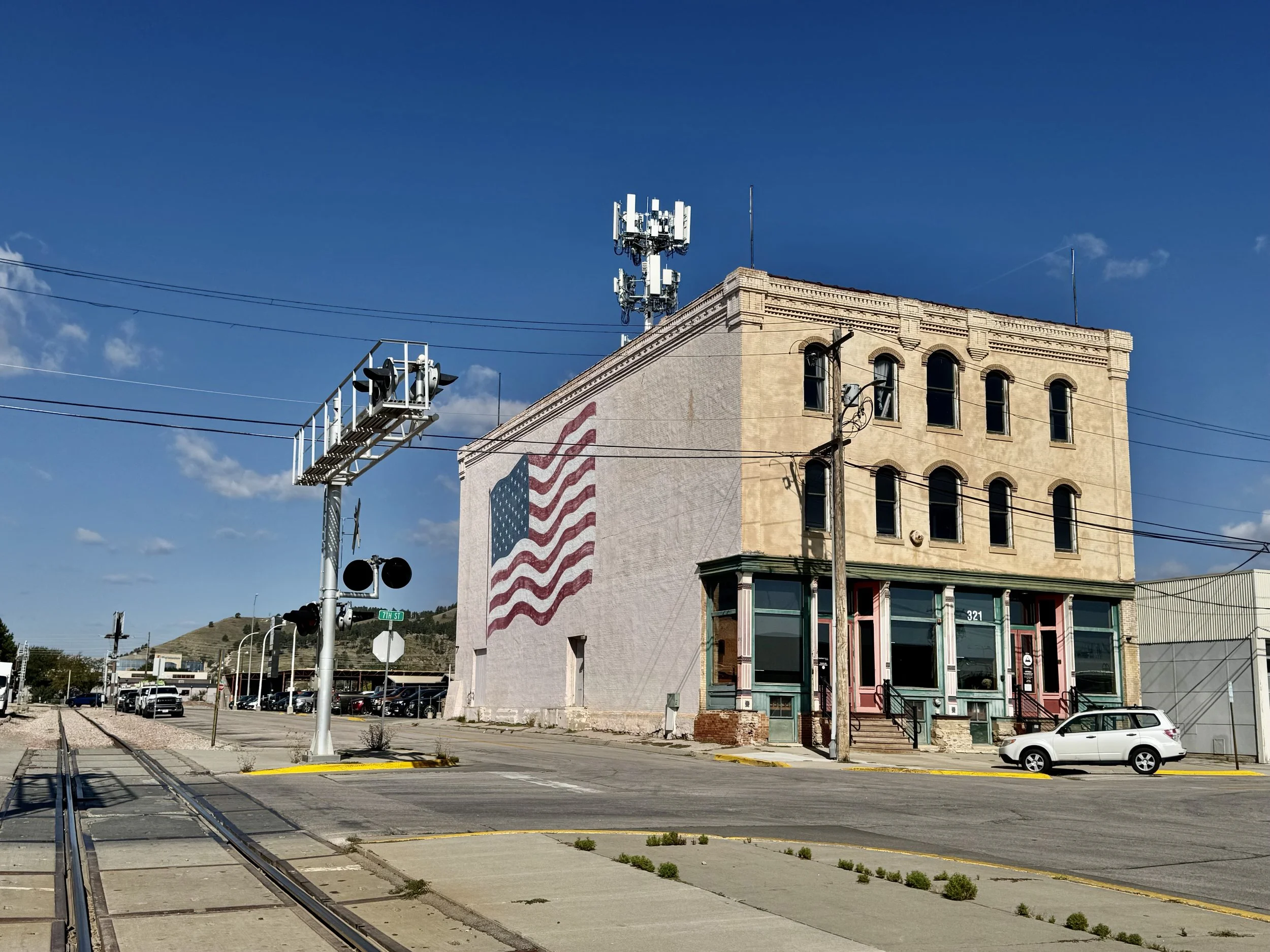
Join David to learn how, despite its rocky start, Rapid City would come to be known as “the Gateway to the Black Hills.”
One hundred and fifty years ago, John Brennan left his Denver, Colorado home to try his hand at finding gold in the Black Hills. After stopping at French Creek, Spring Creek, and Palmer Gulch, he had enough of frozen ground. He and a few other unhappy prospectors abandoned their claims and followed Rapid Creek out of the mountains to establish a regional service center modeled on Denver.
After camping at what they called Point of Rocks, they identified what they thought would be the ideal location for their town. They surveyed a one-square mile townsite along Rapid Creek and named it Rapid City in February 1876. They then began the task of bringing in settlers and attracting businesses. Over the next several years, the town promoters sought trail and railroad connections, developed industries, with an emphasis on ore processing plants, and promoted tourism.
After a rocky start, Rapid City eventually became "the Gateway to the Black Hills,” fulfilling the founders’ vision. This talk will discuss Rapid City’s founding, early struggles, and a few of the activities that allowed Rapid City to grow and prosper. It is based on Wolff’s book, The Gateway to the Hills: Rapid City and the Central Black Hills, volume two in the Black Hills History Tours series published by the South Dakota Historical Society Press.
About David:
David A. Wolff is Professor Emeritus at Black Hills State University where he specialized in South Dakota and Black Hills history and served as Dean of the College of Liberal Arts. Wolff received a Ph.D. from Arizona State University, and has written five books on Black Hills history. Two of them are biographies of Deadwood businessmen, Seth Bullock: Black Hills Lawman and The Savior of Deadwood: James K. P. Miller on the Gold Frontier. Three of the books are part of the Black Hills History Tour series published by the South Dakota Historical Society Press: The Gold Rush, The Gateway to the Hills: Rapid City and the Central Black Hills, and On the Narrow Gauge: The Homestake and Northern Black Hills.
Wolff is a member of several local and regional historical societies and serves as chair of Deadwood’s Adams Museum & House Board of Directors. He has received a number of awards, including Black Hills State University’s Distinguished Faculty Member Award, the Robinson Lifetime Achievement Award from the South Dakota State Historical Society, and the Rodman Paul Award for Outstanding Contributions to Mining History.
Winter/Spring 2026 Individual Tickets NOW AVAILABLE!
Log in to your online portal (accessible via our website) to get your member discount or call the front desk at (605)394-6923 and get your spot saved!