
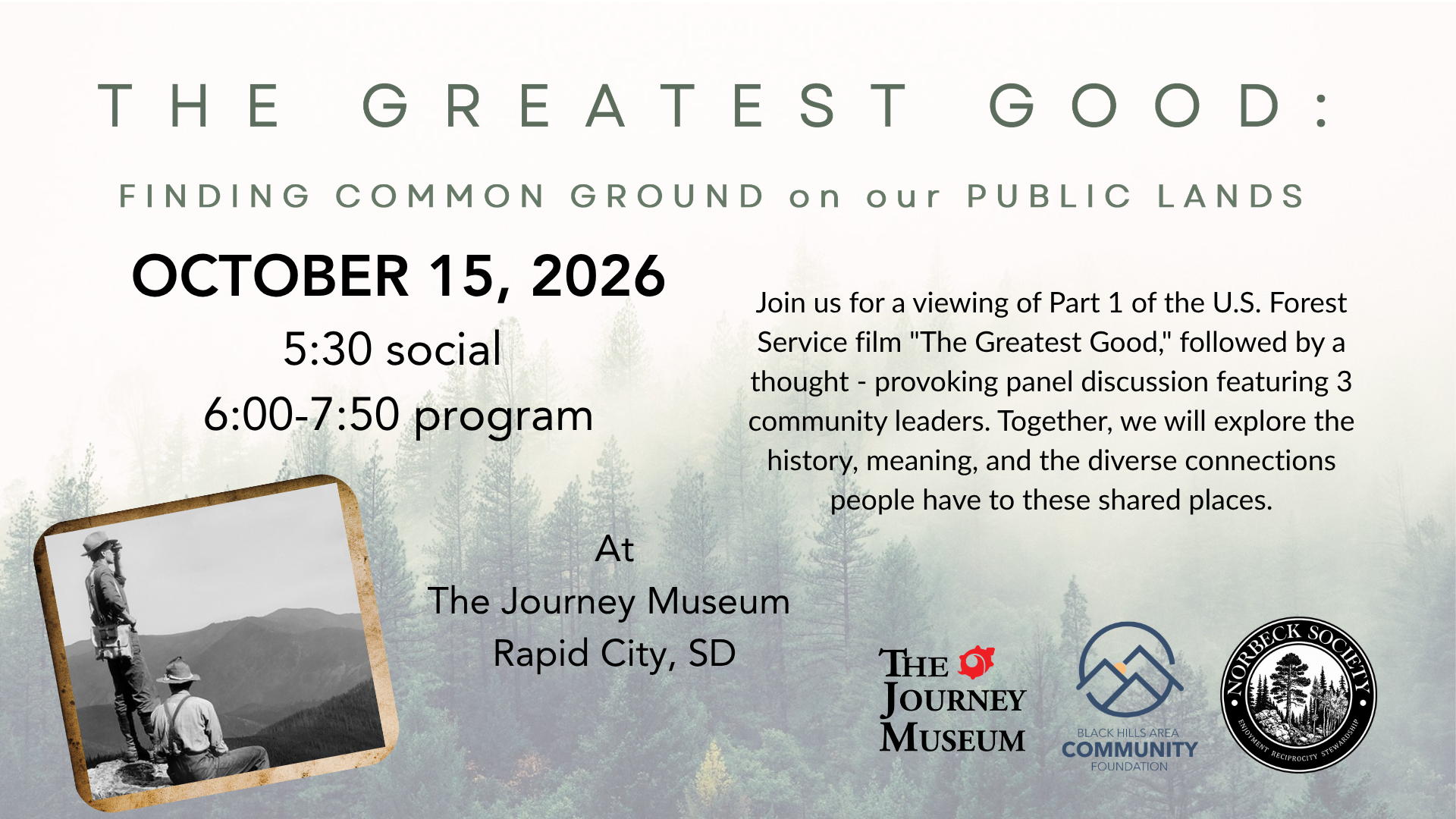
Join us for a screening of Part 1 of the U.S. Forest Service film The Greatest Good, followed by a panel discussion featuring three community leaders.
The film and conversation will examine the history and meaning of our public lands, as well as the many ways people connect with these shared places. The evening offers an opportunity to hear different perspectives, find common ground, and consider how we can work together to protect public lands for generations to come.
5:30 PM - Doors Open and Social
6:00 PM - Film Presentation
6:45 PM - Panel Discussion
Event is FREE and open to the public, but RSVP is required. Click the link below to save your spot.
About the Panelists
-
Valerie Naylor was Superintendent of Theodore Roosevelt National Park and the two other North Dakota national parks from 2003-2014. She was also Superintendent of Scotts Bluff and Agate Fossil Beds National Monuments in Nebraska, and worked for 7 years at Badlands National Park. In her 31 years in the National Park Service, she served as a park ranger, interpreter/naturalist, museum curator, public affairs officer, firefighter, and more in several other western parks.
She has a B.S. Degree in Biology from Eastern Oregon University and a Master's Degree in Biology from the University of North Dakota. She lives in the Black Hills but travels extensively to visit national parks, national forests, and other public lands.
-
Marty Two Bulls Jr. is an artist and educator based in Rapid City, South Dakota. Two Bulls is an enrolled member of the Oglala Sioux Tribe and was raised in the High Plains of South Dakota.
“Mitákuye Oyasin” is a Lakota phrase that loosely translates to "we are all related". It is a philosophy that is directly tied to Lakota culture and religion. We say this phrase in our ceremonies and it is meant to remind us that we are related and interconnected to everyone; even to the plants and animals. It is a phrase meant to reinforce empathy and humility. I believe that using our language in conversation to encourage empathy and humility is powerful.”
-
Paul Horsted of Custer, SD has been a photographer for nearly a half-century and is well known for his precisely "re-photographed" renditions of historic images.
Spanning the Black Hills, Dakotas and National Parks across the USA, and from the 1874 Black Hills “Custer” Expedition to the early days of tourism, his work is well-informed by extensive research of early explorers, pioneering photographers, and the history of these fascinating and beautiful places. His latest book, South Dakota Yesterday & Today, was released in August.
Paul’s books are not only marvels to the eye, but also reveal insights into our history, development, ecology and more across the Black Hills region and beyond.